





- Double Stages High Vacuum Transformer Oil Purifier
- Vacuum Transformer Oil Purification Machine Mounted On Mobile Trailer
- Lube (Turbine/Hydraulic) Oil Purifier
- Single Stage Vacuum Transformer Oil Purifier
- Vacuum Dehydration Oil Purification System
- Insulating Oil Purifier
- Portable Oil Filter Machine
- Coalescing Type Oil Purifier
- Disc-type Centrifugal Oil Separator
- Diesel (Fuel) Oil Filtration System
- Oil Filter Press Machine
- Vacuum Pump Unit
- Air Drying Purification System
- Testing Equipments
- SF6 Gas Treatment Plant
- Accessories: oil filters, vacuum/roots pump, filtering tanks, oil pump, oil blender,etc
Acore Filtration Co. Ltd.
- Tel : +86 132 06063693
- Email : sales@acorefiltration.com
- Mobile & Whatsapp : +8613206063693
- Fax : +86 23 8132 4618
- Add : No.2, Jianhe Road, Banan District, Chongqing, China
Case
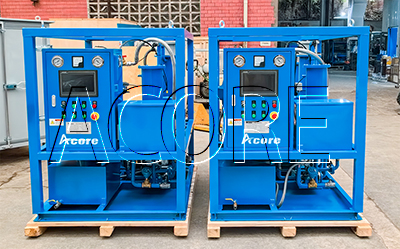
DCS-30(3000L/H) Centrifugal Oil Purifier sales to United Kingdom
December 26,2025.
Centrifugal Oil Separator also often referred to as centrifugal oil
purifier, which is a key technology for efficient and maintenance equipment in
modern industry. It is typically applied in power generation industry, such as steam
turbines, gas turbines, and water turbines, compressor manufacturing and hydraulic
system.
Acore Filtration Co.,Ltd sales two sets of DCS-30(3000L/H) centrifugal oil purifier to United Kingdom to purification of turbine oil in power generation. The core of Centrifugal Oil Separator can be summarized as the efficient and
continuous removal of solid contaminants (e.g., metal wear particles, dust) and
free water from lubricating oil through physical centrifugal force, thereby
significantly extending the service life of lubricant oil and protecting
expensive equipment.
Following is detailed breakdown for specific roles, working principles and
benefits:
1. Core role
Removal of solid contaminants (the most critical role)
Targets: extremely fine metal wear particles (iron, copper, aluminum, etc.),
dust, sand, sealing material debris, oil sludge and carbon deposits.
Importance: These hard particles are the "abrasives" of equipment and
can accelerate the wear of moving parts such as bearings, gears, cylinders,
etc., leading to reduced accuracy, reduced efficiency, and premature failure.
Centrifuges can remove particles as small as 1 micron or even smaller, which is
difficult to achieve with ordinary filters.
The Centrifugal Oil Purifier separate free and emulsified water:
Target: Free water (water that can precipitate) and partially emulsified water
mixed in the oil due to condensation, leakage, or contamination.
Importance: Water can destroy the strength of the oil film, cause rust,
accelerate the oxidation and deterioration of the oil, and may breed
microorganisms to form oil sludge. Centrifuges can efficiently separate and
drain dense water.
By continuously removing contaminants, the cleanliness of the lubricating oil
(e.g. ISO 4406) can be stabilized at a very high level (e.g. ISO 14/12/10 or
higher) for a long time, which is a prerequisite for the reliable operation of
critical equipment such as hydraulic systems, turbines, compressors, etc.
Due to the continuous centrifugation of contaminants, the oxidation rate of the
oil is greatly reduced and the acid value increases slowly, thereby extending
the service life of the lubricating oil several times.
Working principle:
Centrifugal Oil Purifier do not rely on
filter media and work based on Stokes' law and density differences:
High speed rotation creates a strong centrifugal force: dirty oil is pumped
inside a rotor (bowl) that rotates at high speeds (usually thousands of
revolutions per minute).
Density stratification: Under the action of centrifugal force hundreds to
thousands of times greater than specific gravity, components of different
densities in the oil are rapidly stratified:
Outermost layer (densest): solid impurities (such as metal particles).
Mesosphere: Free water.
Innermost layer (least dense): clean lubricant.
Separation and Discharge:
The rotor of Centrifugal Oil Separator is designed with a special lamination
group or cylinder structure to guide and contain the separated contaminants.
Solid dirt adheres to the inner wall of the rotor, forming a strong sludge
layer that needs to be cleaned regularly by hand.
Free water (if present) is separated to a specific area and can be discharged
manually or automatically.
Clean oil flows out of the center of the rotor and returns to the tank or
directly to the equipment.
A simple analogy: Just like when a washing machine is spinning, the water (low
density) is thrown to the inner layer to drain away, and the clothes (high
density) are pressed against the walls of the bucket. The logic of centrifuges
handling oil is similar.
Summary
The role of Centrifugal Oil Purifier is essentially "preventive maintenance of oil". It actively and continuously "throws" the wear particles and moisture that are most harmful to the equipment out of the oil through a powerful centrifugal force, rather than passively waiting for the filter to clog. This not only protects the equipment and reduces downtime, but also reduces the overall lifecycle maintenance costs of the equipment by significantly extending the life of the oil and filter elements, making it an efficient, environmentally friendly and economical solution for oil purification.


 +8613206063693
 Rufus Huang
 sales@acorefiltration.com
 +8613206063693
 +86 23 8132 4618